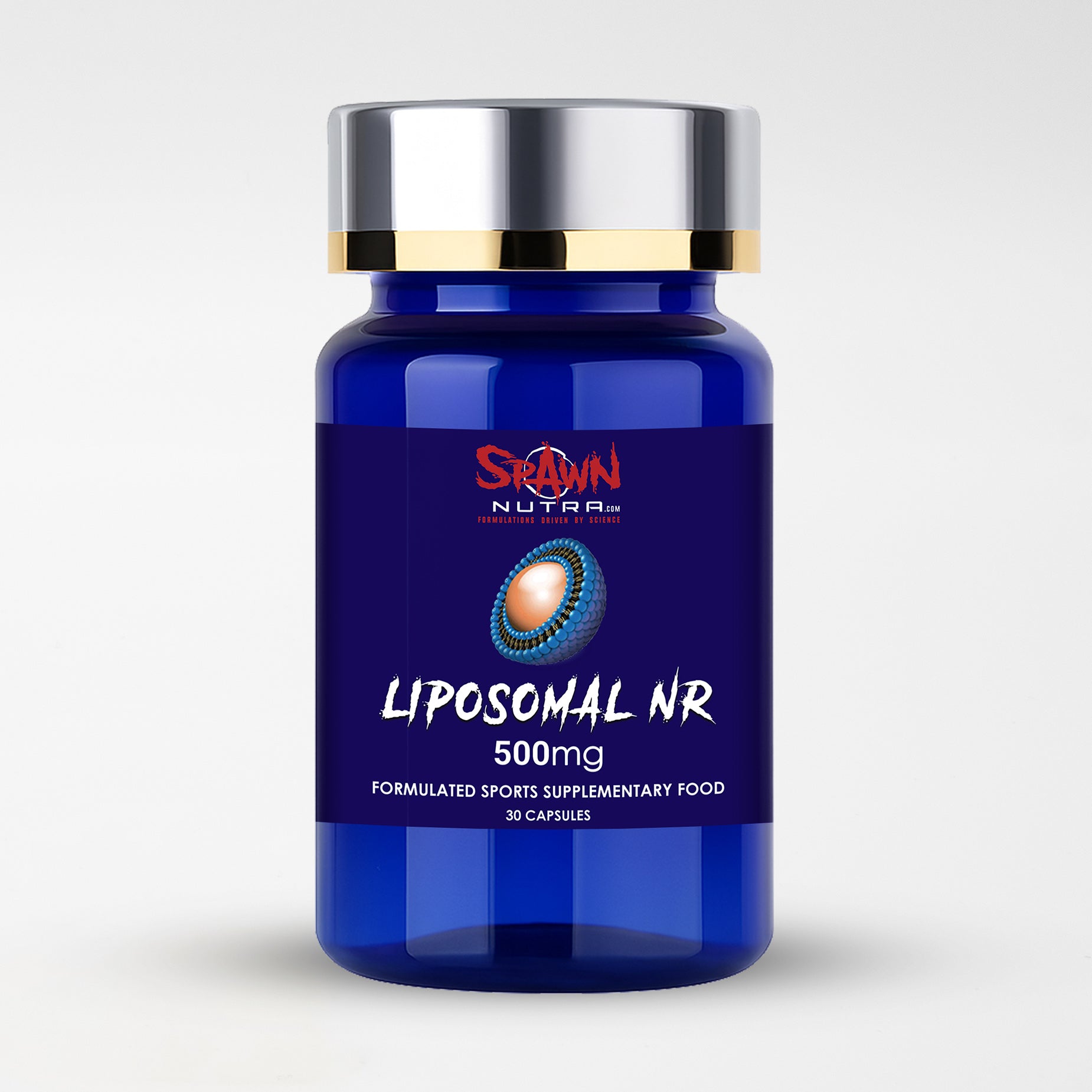
LIPOSOMAL Nicotinamide Riboside (NR)
- Regular price
-
$69.95 - Regular price
-
- Sale price
-
$69.95
LIPOSOMAL NR 500MG
The Neurological NAD+ Pathway.
WHAT IS NR?
Nicotinamide Riboside. NR is a naturally occurring NAD+ precursor found in trace amounts in milk, yeast, and certain fermented foods. In the human body, NR is converted to NMN via NRK1/NRK2 (nicotinamide riboside kinase), and NMN is then converted to NAD+. NR and NMN share the same final destination but travel different metabolic routes — and those different routes mean they have meaningfully different tissue distribution profiles.
While NMN has demonstrated superior kinetics for skeletal muscle, liver, and gut tissue, NR has a distinct advantage in neurological tissue. NR is a substrate for nucleoside transporters — specifically CNT (concentrative nucleoside transporter) and ENT (equilibrative nucleoside transporter) families — which are expressed at high density in the blood-brain barrier and central nervous system. NMN, being a nucleotide rather than a nucleoside, does not benefit from the same transport system. For neurological NAD+ replenishment, NR has a physiological edge.
THE MOLECULAR MECHANISMS
NR and Neurological NAD+ Replenishment
The brain is one of the most metabolically demanding organs in the body — consuming approximately 20% of total body energy despite representing only 2% of body weight. Neuronal mitochondria are under continuous high-demand energy production, making the NAD+/NADH ratio in neural tissue a critical variable in cognitive function, neurotransmitter synthesis, and synaptic maintenance. Age-associated NAD+ decline in neural tissue contributes to reduced mitochondrial membrane potential, increased oxidative stress, reduced SIRT1-SIRT3 activity, and impaired neuronal DNA repair. NR replenishment via CNT/ENT transport — the neurological nucleoside highway — efficiently restores neural NAD+ pools with a tissue specificity that NMN cannot match.
SIRT3 and Mitochondrial Quality Control
SIRT3 — the mitochondrial sirtuin — is activated by NAD+ and deacetylates numerous mitochondrial enzyme complexes including Complex I, Complex II, Complex III, succinate dehydrogenase, and isocitrate dehydrogenase 2, increasing their catalytic efficiency. SIRT3 also deacetylates and activates SOD2 (superoxide dismutase 2) — the primary mitochondrial antioxidant enzyme. Without adequate NAD+, SIRT3 activity collapses, mitochondrial enzyme complexes become hyperacetylated and underperform, and mitochondrial reactive oxygen species accumulate. NR-driven NAD+ replenishment in neural tissue reactivates SIRT3 and restores mitochondrial quality control.
NR and Axonal Protection
Research on Wallerian degeneration — the process by which injured axons self-destruct — has revealed that NAD+ depletion is the trigger. The WLDS (slow Wallerian degeneration) gene contains NMNAT, an NAD+ biosynthetic enzyme, and its overexpression dramatically delays axonal degeneration after injury. This establishes a direct mechanistic link between axonal NAD+ availability and neurological resilience. NR, by efficiently replenishing neural NAD+ pools, supports the same protective mechanism.
NR and Inflammatory Gene Suppression
SIRT1 in immune cells deacetylates NF-κB p65, reducing transcription of pro-inflammatory cytokines including TNF-α, IL-1β, and IL-6. In activated macrophages and microglia, NAD+-dependent SIRT1 activity functions as a molecular brake on neuroinflammation. Restoring NAD+ via NR supplementation reactivates this brake — an effect particularly relevant in aged neural tissue where chronic low-grade inflammation (neuroinflammation) drives accelerated cognitive decline.
WHY STANDARD ORAL NR UNDERPERFORMS
NR faces significant first-pass metabolism. In the small intestinal lumen, NR is converted to nicotinamide by NRK in intestinal cells, and what remains passes into portal circulation where hepatic NRK and phosphatase activity further degrades it. Studies using isotopically labelled NR show that a substantial proportion of oral NR is absorbed as nicotinamide and then reconverted to NMN and NAD+ in peripheral tissue via the salvage pathway — a longer route with greater attrition at each step. Standard oral NR bioavailability: ~35–45%.
THE LIPOSOMAL ADVANTAGE
|
Standard Oral NR (Capsule/Tablet) |
~35–45% effective bioavailability. First-pass conversion to nicotinamide reduces the proportion reaching tissue as intact NR. Neurological uptake depends on what survives hepatic processing. |
|
Spawn Nutra Liposomal NR 500mg |
~85% effective bioavailability. Phospholipid encapsulation bypasses luminal NRK conversion. Intact NR is delivered directly to portal circulation and from there to CNT/ENT transporters in neurological tissue. Peak plasma NR and plasma NAD+ metabolomics significantly elevated vs standard oral equivalent. |
Spawn Nutra combines Liposomal NMN and Liposomal NR as a precision dual-pathway NAD+ stack — each optimised for different tissue targets. NMN for peripheral, metabolic, and muscular NAD+ replenishment. NR for neurological and CNS NAD+ replenishment. Together, they provide complete systemic NAD+ elevation that single-precursor approaches cannot achieve.
MAD SCIENTIST 5150 — FORMULATE TO DESTROY
While every other brand picks one NAD+ precursor, Spawn Nutra built the stack. NMN for the body. NR for the brain. Both liposomal. Both delivered intact. This is what total NAD+ replenishment looks like.
Shipping information
- No EU import duties.
- Ships within 1-2 business days.
- Ships in our fully recyclable and biodegradable signature boxes.
Couldn't load pickup availability