
Liposomal NAD 1000mg
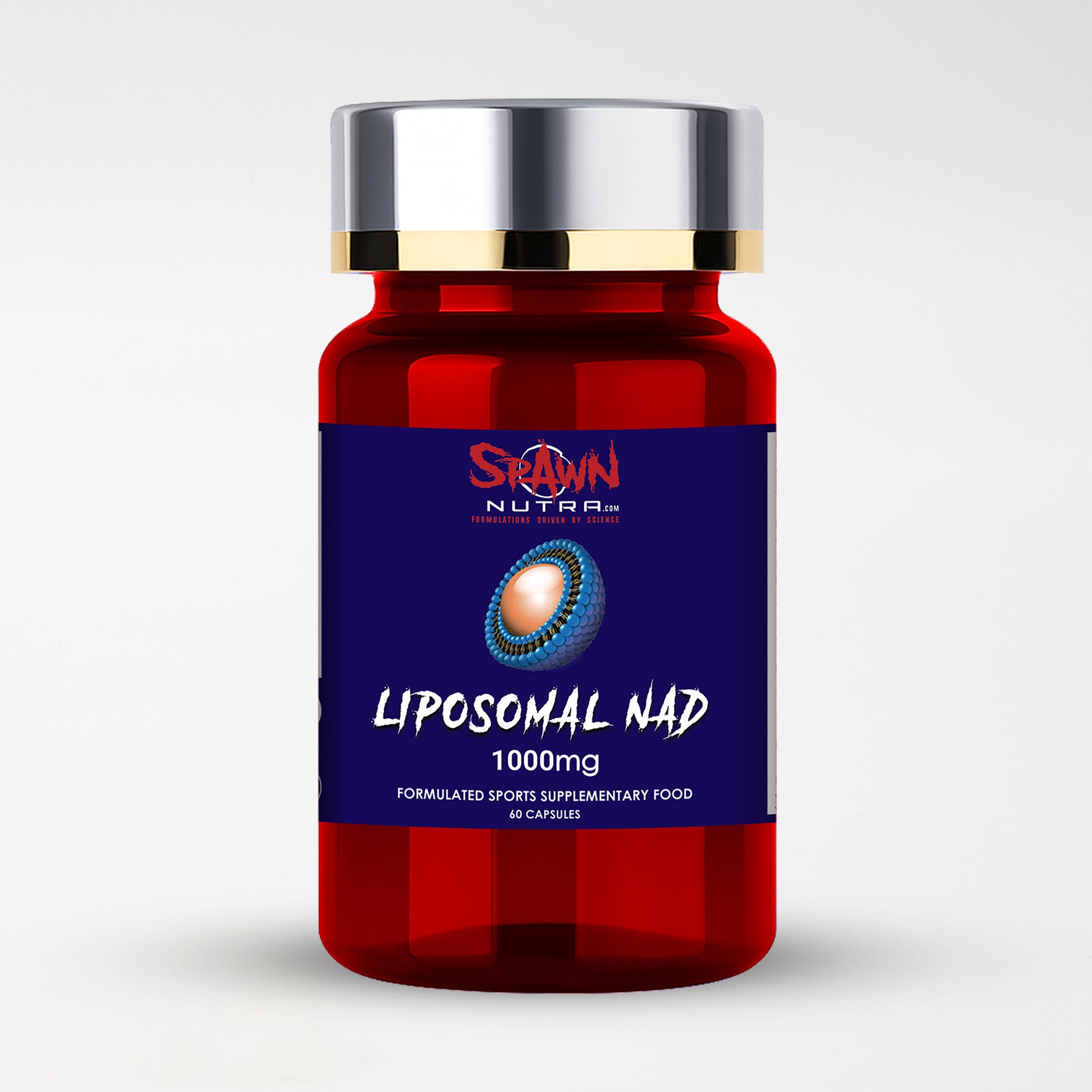
Liposomal NAD 1000mg
LIPOSOMAL NAD+ 1000MG
The Cellular Currency. Delivered Where It Counts.
WHAT IS NAD+?
Nicotinamide Adenine Dinucleotide. It is not a supplement trend. It is the primary coenzyme in every mitochondrial energy-producing reaction in the human body. Without NAD+, your cells cannot complete oxidative phosphorylation — the process by which glucose and oxygen become ATP. You are not supplementing for a benefit. You are replenishing a coenzyme your biology requires to function.
NAD+ exists in two forms — NAD+ (oxidised) and NADH (reduced). The ratio between these two forms is a direct readout of your cellular metabolic state. As NAD+ is consumed producing NADH in the electron transport chain, it must be continuously regenerated. The NAD+/NADH ratio in healthy, young mitochondria sits around 700:1. In aged, metabolically impaired tissue, this ratio collapses. Energy production drops. DNA repair stalls. Sirtuin activity halts.
By the age of 50, NAD+ levels in most tissues have declined by 40–50% compared to levels at age 20. This is not a coincidence — it is one of the foundational mechanisms of biological aging. The decline of NAD+ maps directly to the decline of mitochondrial function, sirtuin-mediated longevity signalling, and PARP-mediated DNA repair.
THE MOLECULAR MECHANISMS
Sirtuin Activation (SIRT1–SIRT7)
Sirtuins are NAD+-dependent deacylases — enzymes that remove acetyl and acyl groups from histones and transcription factors, regulating gene expression, DNA repair, mitochondrial biogenesis, inflammation, and metabolic homeostasis. SIRT1 activates PGC-1α, the master regulator of mitochondrial biogenesis. SIRT3 deacetylates mitochondrial enzymes, increasing oxidative phosphorylation efficiency. SIRT6 coordinates base excision repair and telomere maintenance. None of these enzymes can function without NAD+. When cellular NAD+ drops, sirtuin activity drops. When sirtuin activity drops, aging accelerates.
PARP-Mediated DNA Repair
Poly(ADP-ribose) polymerases — PARP1 in particular — are activated by DNA strand breaks and consume NAD+ to synthesise poly(ADP-ribose) chains as signalling scaffolds for the DNA repair machinery. A single double-strand DNA break can activate PARP1 and consume hundreds of NAD+ molecules. In tissues under chronic oxidative stress — which is every tissue in an aging body — persistent PARP activation creates an NAD+ sink that outcompetes mitochondrial and sirtuin demands. Elevating NAD+ resolves this competition, allowing DNA repair and longevity signalling to coexist.
CD38 and Immunological NAD+ Consumption
CD38 is an ectoenzyme expressed on immune cells that degrades NAD+ as part of cyclic ADP-ribose signalling. In aging and chronic inflammation, CD38 expression increases dramatically — and because it has an extremely high catalytic activity, it becomes the dominant consumer of NAD+ in aged tissue. The result is a cellular NAD+ deficit that is driven not by inadequate biosynthesis but by enzymatic destruction. Maintaining elevated NAD+ through supplementation compensates for this drain.
WHY STANDARD ORAL NAD+ FAILS
NAD+ is a dinucleotide — a large, hydrophilic, negatively charged molecule with a molecular weight of 663 Da. The human GI tract is designed to break it down before absorption. Intestinal nucleotidases cleave the phosphodiester bond, releasing nicotinamide mononucleotide (NMN) and adenosine monophosphate. The NMN is then further degraded to nicotinamide and ribose-5-phosphate before entering the portal circulation as free nicotinamide. Your cells then have to reassemble NAD+ from scratch via the salvage pathway. Standard oral NAD+ bioavailability: 30–40%, and what is absorbed is largely absorbed as metabolites, not intact NAD+.
THE LIPOSOMAL ADVANTAGE
|
Standard Oral (Powder/Capsule) |
30–40% bioavailability — largely absorbed as NAD+ metabolites post-GI degradation. Slow absorption, high loss. |
|
IV NAD+ Infusion |
100% systemic availability but requires clinical administration, is expensive, and has a short half-life due to rapid clearance. |
|
Spawn Nutra Liposomal NAD+ 1000mg |
~85% effective bioavailability — phospholipid bilayer encapsulation protects intact NAD+ from nucleotidase degradation during GI transit. Nanovesicles fuse directly with enterocyte membranes, releasing NAD+ intracellularly before systemic clearance. Peak plasma NAD+ metabolomics significantly superior to equivalent oral dose. |
At 1000mg per serving, Spawn Nutra Liposomal NAD+ delivers more functionally available NAD+ per dose than any oral competitor on the market. The liposomal encapsulation does not just improve absorption — it changes the site of action. Rather than delivering NAD+ precursors to the liver for partial conversion, liposomal delivery provides intact NAD+ directly to enterocyte and portal cell mitochondria, the first tissues to benefit from each dose.
MAD SCIENTIST 5150 — FORMULATE TO DESTROY
Your mitochondria are running on a depleted fuel system. Standard NAD+ supplements send precursors and hope for conversion. Spawn Nutra delivers the active molecule intact at 85% bioavailability. There is no competition.