
Liposomal Methylene Blue 10mg - World First
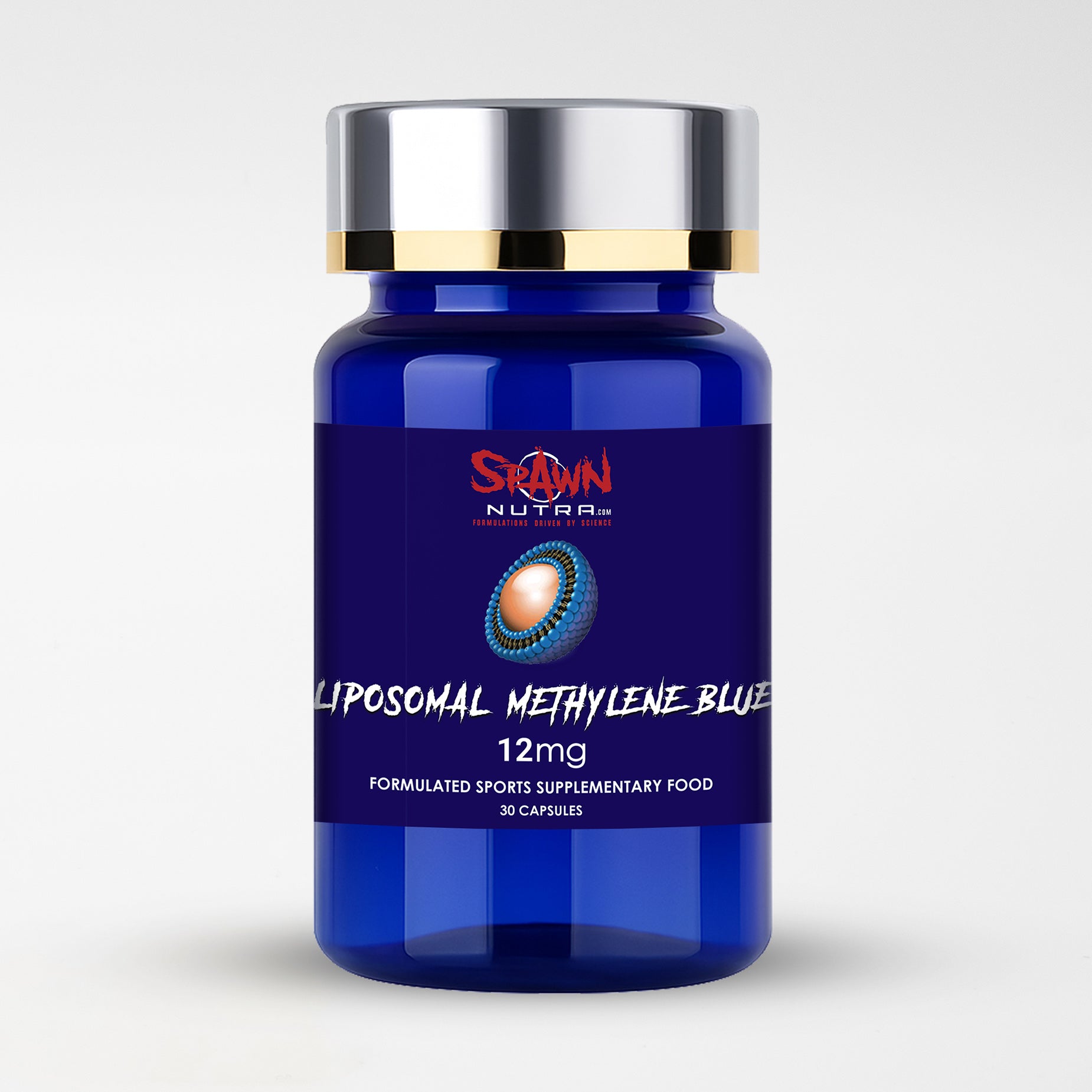
Liposomal Methylene Blue 10mg - World First
LIPOSOMAL METHYLENE BLUE 12MG
The Mitochondrial Electron Carrier. 100 Years of Clinical History. Finally Biooptimised.
WHAT IS METHYLENE BLUE?
Methylene Blue (MB) is a phenothiazinium compound first synthesised in 1876. It was the first fully synthetic drug used in clinical medicine — initially for malaria treatment — and has since been approved by the FDA for methemoglobinaemia, cyanide poisoning, and ifosfamide-induced encephalopathy. It has one of the longest documented clinical safety records of any compound in pharmacological history. And yet, its most relevant biological activity for performance and longevity applications was not fully characterised until the last two decades: methylene blue is an alternative electron carrier in the mitochondrial electron transport chain.
MB exists in two redox states: the oxidised blue form (MB+) and the reduced colourless form (leucomethylene blue, MBH2). This redox cycling — MB+ accepting electrons and becoming MBH2, then donating electrons to Complex IV (cytochrome c oxidase) and returning to MB+ — allows MB to directly bypass damaged or dysfunctional Complex I, II, or III and shunt electrons directly to the terminal oxidase. In cells where upstream ETC dysfunction has impaired ATP production, MB restores electron flow and ATP synthesis through a completely different channel.
THE MOLECULAR MECHANISMS
Mitochondrial ETC Enhancement
In healthy mitochondria, MB increases the efficiency of Complex IV (cytochrome c oxidase), the terminal electron acceptor that reduces molecular oxygen to water. MB has a higher affinity for cytochrome c than Complex III does, meaning it can increase the rate of electron delivery to Complex IV even when upstream complexes are functioning normally. This translates to increased mitochondrial oxygen consumption and ATP production — effectively acting as a metabolic accelerator at the final step of oxidative phosphorylation.
Neuroprotection — Alzheimer's Disease Research
Tau protein hyperphosphorylation and aggregation is the primary intraneuronal pathology of Alzheimer's disease. MB inhibits tau aggregation by preventing the formation of tau-tau cross-links — an activity that has made it the basis of several clinical Alzheimer's drug development programs (LMTM, a second-generation MB derivative, completed Phase III trials). Beyond tau, MB also reduces amyloid beta production, inhibits monoamine oxidase (increasing catecholamine availability), and promotes autophagic clearance of misfolded proteins. Preclinical evidence consistently demonstrates that MB is neuroprotective across multiple Alzheimer's pathological mechanisms simultaneously.
Cognitive Enhancement and Cerebral Blood Flow
MB crosses the blood-brain barrier rapidly and freely — a consequence of its small size (319 Da) and lipophilicity. In the brain, MB increases cytochrome c oxidase activity in neurons, increases BDNF (brain-derived neurotrophic factor) expression, and improves cerebral blood flow via nitric oxide modulation. Human functional MRI studies have demonstrated that low-dose MB (0.5–4mg/kg) increases fMRI-BOLD signal in task-activated brain regions — a direct readout of increased neuronal metabolic activity. Memory enhancement, particularly episodic memory encoding and retrieval, has been documented in clinical studies at doses overlapping with the 12mg dose in Spawn Nutra Liposomal Methylene Blue.
Antimicrobial and Anti-Biofilm Activity
Methylene blue is a photosensitiser — in the presence of visible light, it generates singlet oxygen and reactive oxygen species that are selectively toxic to microorganisms. This activity forms the basis of photodynamic therapy using MB for oral, wound, and sinus infections. It also has direct antimicrobial activity against certain intracellular pathogens (Plasmodium, Leishmania) independent of light activation.
DOSE, SAFETY, AND THE HORMETIC WINDOW
Methylene Blue demonstrates hormesis — a dose-response relationship where low doses have the opposite effect to high doses. Low doses (0.5–2mg/kg, approximately 5–140mg for average adults) enhance mitochondrial function, reduce ROS, and provide neuroprotection. High doses (>4mg/kg) paradoxically inhibit monoamine oxidase excessively, increase ROS production, and can cause serotonin syndrome in combination with serotonergic drugs. Spawn Nutra Liposomal Methylene Blue at 12mg is designed to operate within the established hormetic window — the low-dose zone where all of MB's beneficial mechanisms are active and none of its adverse pharmacology applies.
Contraindication note: MB is a monoamine oxidase inhibitor and should not be combined with SSRIs, SNRIs, MAOIs, or other serotonergic drugs. It is not appropriate for individuals with G6PD deficiency.
THE LIPOSOMAL ADVANTAGE
|
Standard Oral MB |
~72% oral bioavailability — MB is actually reasonably absorbed in standard form due to its small MW and partial lipophilicity. Peak plasma at 1–2 hours. However, CNS delivery is limited by the efficiency of blood-brain barrier penetration at standard formulations. |
|
Spawn Nutra Liposomal MB 12mg |
~85–92% effective bioavailability. Liposomal encapsulation does not dramatically change GI absorption (already reasonable) but significantly improves lymphatic delivery, CNS penetration via phospholipid-mediated BBB transport, and consistency of plasma kinetics. The primary advantage is predictable peak plasma levels and enhanced CNS bioavailability. |
MAD SCIENTIST 5150 — FORMULATE TO DESTROY
A drug older than aspirin that still outperforms every synthetic nootropic on the market for mitochondrial and neurological benefit. Spawn Nutra Liposomal Methylene Blue 12mg — the first liposomal methylene blue in commercial supplement history. This is what the horizon looks like.